It comes round every May, and it always sneaks up
Mental Health Awareness Week lands in May every year in the UK, and every year we get the same phone calls in April asking if we can do something 'next week.' Sometimes we can. Often the diary's already full of other people's April panic, and the honest answer is we can't get a teacher to you until June, which rather defeats the point.
None of this is a criticism of anyone doing the calling. Awareness weeks have a habit of arriving with more notice on the calendar than in anyone's actual working week. But if it matters to your team, it's worth treating like any other date you wouldn't leave to chance.
Why booking early actually matters
The practical reason is simple: good teachers get booked up, especially in the fortnight either side of the week itself, when half of London's offices have the same idea at the same time. Booking six to eight weeks out gives you first pick of times and formats, rather than whatever's left.
There's a less practical reason too. A session that's been planned properly, communicated in advance, given a decent slot, not squeezed into a lunch hour nobody actually has free, lands differently to one that's clearly been arranged in a hurry. People notice the difference, even if they couldn't say why.
Formats that work well for the week
There's no single right way to mark it, and the best choice usually depends on what your team is like on a normal Tuesday, not what looks good in an email.
- Mindfulness sessions — short, guided, no experience needed; good for teams who'd rather not 'do yoga' in front of colleagues
- A massage day — chair massage set up in a meeting room or quiet corner, people booked into fifteen or twenty minute slots through the day
- A short workshop — practical, on things like sleep or managing a heavy week, rather than anything too clinical
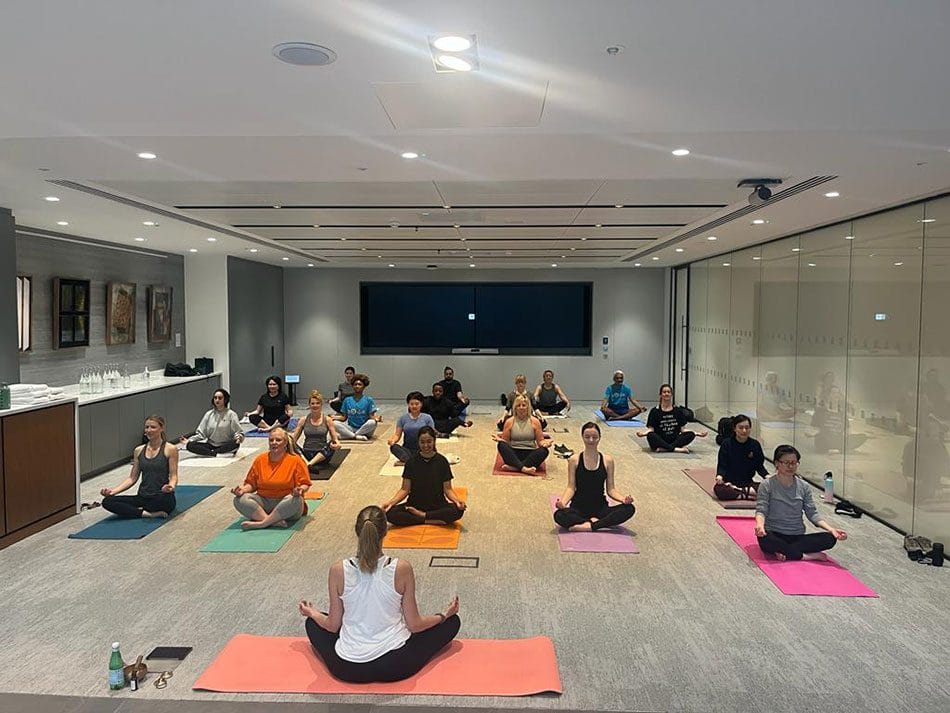
- A one-off yoga or movement class — works well as an actual break in the day rather than an add-on to it
Making it more than a gesture
The honest risk with any awareness week is that it becomes a single email and a single hour, then nothing changes until the same week next year. That's not a reason to skip it. One good session is still a good session. But it's worth being clear-eyed about what it can and can't do on its own.
What tends to land well is treating the week as a visible marker of something that continues quietly the rest of the year, rather than the whole of the effort. Even something small, a regular slot booked in for the months after, or simply asking the team what actually helped, does more than the week on its own ever will.
We've been doing this in London offices since 2012, and the teams who get the most out of it are usually the ones who ask 'what should we do differently after this week,' not just 'what should we do during it.'
A simple timeline, if you want one
Six to eight weeks out: get in touch, pick a format, get a date in the diary. Two to three weeks out: let the team know what's happening and when, so it doesn't land as a surprise on the day.
The week itself: run it somewhere people can actually relax, a meeting room or a cleared corner is enough, we bring what's needed. Afterwards: ask what worked. That's the bit that turns one week into something that carries on.
Quick answers
How far ahead should we book for Mental Health Awareness Week?
Six to eight weeks gives you the best choice of times and formats. Closer to the week itself, options narrow fast.
Do we need a lot of space?
No. A meeting room or a clear corner of the office is usually enough. We bring what's needed and work with what's there.
What if we can't get a slot in the week itself?
The nearest week either side still counts. What matters more is that it happens, not the exact date.