Ambitious plans don't survive a Tuesday
Most mindfulness advice is written for a version of the day that doesn't exist: twenty quiet minutes before anyone else is up, a cushion, no emails. Real working days don't look like that, and a practice that only works in ideal conditions is a practice that gets dropped by the second week of January.
What actually survives is smaller and less ambitious than people expect. Five minutes, done on a day that's already busy, beats twenty minutes that only happens when everything else has gone quiet, which in most offices is never.
A handful of five-minute versions
None of these need a room, an app, or anyone else's involvement. They fit into gaps that already exist in the day.
- Breath counting — ten slow breaths before opening your laptop in the morning, or before a call you're dreading
- The walk to the kettle — a few minutes of noticing your feet on the floor instead of rehearsing what you're about to say to someone
- One email, properly — reading and writing a single message without a second tab open, just to remember what that feels like
- An actual lunch break — away from the desk, even if it's only fifteen minutes, even if it's just the office kitchen
Why short beats ambitious
The five-minute version works for a boring reason: it's easy to start. There's no barrier of 'I need to set aside proper time,' which is the exact thought that means it never happens. You can do it between meetings, in a lift, at your desk with your eyes open.
It also works because it's repeatable. A five-minute practice you actually do most days does more than a forty-minute one you do twice and then feel guilty about. Consistency, not duration, is what makes any of this worth anything at all.
Attaching a practice to something you already do helps more than picking a fixed time on the clock. Ten breaths right as you sit down at your desk, rather than 'sometime in the morning,' means you don't have to remember to do it separately. The routine you already have carries the new habit along with it.
Nobody needs to know you're doing it
One of the quiet advantages of all four versions above is that they don't look like anything from the outside. Breath counting looks like someone gathering their thoughts before opening a laptop. The kettle walk looks like making tea, because it is making tea. Reading one email properly looks exactly like reading an email.
That matters in an office where announcing 'I'm just doing five minutes of mindfulness' is precisely the kind of sentence that makes people never actually do it. None of this needs an audience, a name, or an explanation to a colleague walking past. It just needs five minutes and a bit of attention.
Where this fits with what we do
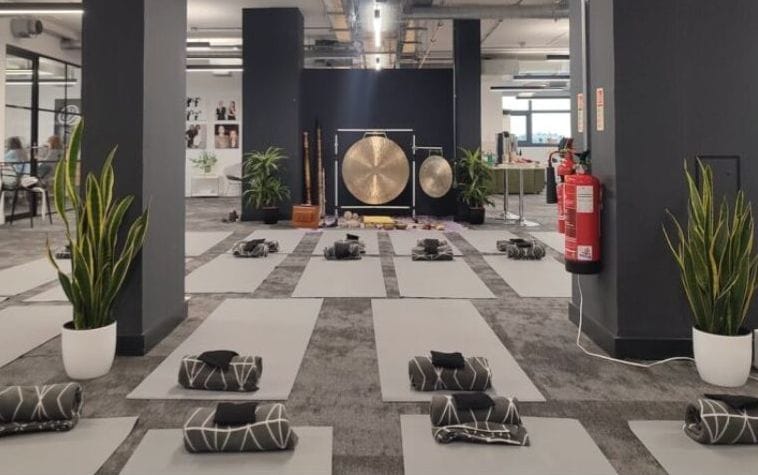
The five-minute versions are things people can do alone, any day, without booking anything. They're not a replacement for a proper mindfulness session with a teacher in the room. Those go deeper, and give people a chance to actually stop rather than squeeze something in around everything else, but they're a decent bridge on the days there isn't one scheduled.
We run short guided sessions in offices for exactly this reason: to give people fifteen or twenty minutes that isn't secretly still work, and to make the five-minute versions feel more familiar rather than like homework from a course nobody signed up for.
Start with one
Don't try to add all four to your day at once. Pick the one that fits most naturally into a gap you already have, and leave it there for a couple of weeks before adding anything else. The kettle walk is usually the easiest place to start, mostly because you were going to make that walk anyway.
Quick answers
Do these practices need any equipment or an app?
No. All of them work with nothing more than a few minutes and a willingness to actually pay attention for that long.
What if five minutes still feels like too much some days?
Then it's a day for the breath count and nothing else. Something small most days beats something bigger some days.